When and how customers can return purchases for a refund can depend on the laws in your region and on your returns policy. Laws and policies often include time limits, affecting both the period during which you must accept returns and the timescales for the returns process. Here's what you need to know and do.
Use FreePrivacyPolicy.com to generate the necessary legal agreements for your website/app:
- Free Privacy Policy Generator
- Free Terms and Conditions Generator
- Free Cookies Policy Generator
- Free Disclaimer Generator
- Free EULA Generator
- Free Return & Refund Policy Generator
You check our Free Cookie Consent to start making your business legally compliant with the Cookies Directive in the EU.
- 1. How Do Time Limits Work in Return & Refund Laws?
- 1.1. Faulty Goods
- 1.2. Voluntary Returns
- 1.3. Exemptions
- 2. What Are the Time Limits Under Different Laws?
- 2.1. United States
- 2.1.1. Faulty Goods
- 2.1.2. Voluntary Returns
- 2.2. Europe
- 2.2.1. Faulty Goods
- 2.2.2. Voluntary Returns
- 2.2.3. Other European Countries
- 2.3. Australia
- 2.4. Canada
- 3. How To List Time Limits
- 4. Where To List Time Limits
- 5. Summary
How Do Time Limits Work in Return & Refund Laws?
In this guide we'll be looking at time limits for returns and refunds for some specific laws around the world. In virtually every case, three main questions affect any time limit:
- Is the return because the goods have a fault?
- What are the rules on "voluntary" returns?
- Is there a specific exemption for a particular product?
Let's break that down in detail.
Faulty Goods
In almost every jurisdiction, people have the right to return goods and get a refund if they don't work or are otherwise not as described. This can be through specific consumer laws or more general principles of legal contracts. Many laws have a time limit after which either the right no longer applies or the burden of proof changes from the seller having to show the goods were fit for purpose to the buyer having to show they were faulty..
Voluntary Returns
In most cases, the law sets out one of three situations:
- The buyer has a legal right to return goods and get a refund for any reason. A time limit often applies.
- The buyer has a default right to return goods and get a refund for any reason unless you post a clear notice (or have a clear policy) to the contrary.
- The buyer has no automatic right to return goods and get a refund policy. You can choose to have a returns policy granting them this right (for example, as a way to attract customers). If so, you must live up to this policy.
Exemptions
With most voluntary returns (whether through a legal requirement or your policy), some goods are exempt from the usual rights and rules. These commonly include any goods that are customized or made to order; digital products (which could be copied or ‘used' before a return); perishable goods (such as fresh foods); and intimate items of clothing.
What Are the Time Limits Under Different Laws?
Now we've covered the key points to check for each law, here are some specific details from major laws around the world.
United States

The laws and time limits for returns and refunds in the US vary significantly between states and whether the goods are faulty.
Faulty Goods
Refunds for faulty goods come under federal law, though they are treated as a contract condition. Whenever you sell something, you are making an implied contract condition that the goods are merchantable. This means they are of "fair average" quality, are suitable to fulfil their usual purpose, and follow any promises in your labelling or packaging.
In principle, if you refuse to give a refund, a customer will have to sue you for breach of contract. A court would then have to decide if they had done so within a reasonable time, taking into account how long an item was expected to last. As there's no fixed timeline for how long any specific item should last, the outcome of such a case could be unpredictable. In practice, it's normally sensible to issue refunds rather than risk losing a court case and having to pay your legal costs and those of the customer.
Voluntary Returns
Federal law gives customers a very limited legal right to a refund if they have changed their mind. This is through the FTC Cooling-Off Rule, which mainly covers sales made in a customer's home or somewhere other than your place of business, for example at a convention. If the rule applies, customers can exercise it until three days after the purchase, not including Sundays or federal holidays. You then have 10 days to issue the refund.
Beyond this, voluntary returns come under state laws. In some states, customers have no legal right to a voluntary return, so it's up to any store policy you have (including any time limit.)
In other states, legal rules either apply all the time, or apply by default unless you have a prominent notice or policy that says otherwise.
The following states have default rules which include some form of time limit. In each of these cases you must accept voluntary returns within this time limit and issue refunds, unless you have a conspicuous policy which lists a different time limit or says you don't accept voluntary returns.
- California: 30 days. (If you do have a time limit in your returns policy, it can't be less than seven days.)
- Connecticut: 7 days.
- Florida: 7 days.
- Hawaii: 60 days.
- Maryland: A "reasonable" period.
- Minnesota: A "reasonable" period. (A "no-returns" policy or a time limit is only valid if the policy is displayed in bold type of at least 14 points.
- New Jersey: 20 days.
- New York: 30 days.
- Rhode Island: 10 days.
In Ohio and Utah, unless you have a policy saying otherwise, there's no specific time limit on voluntary returns. In Virginia, you must publish a refund policy unless you offer cash/credit card refunds on unused goods within 20 days.
Note that many states with this type of rule have exemptions, for example for perishable or customized goods.
Here are a couple of examples of how these rules work.
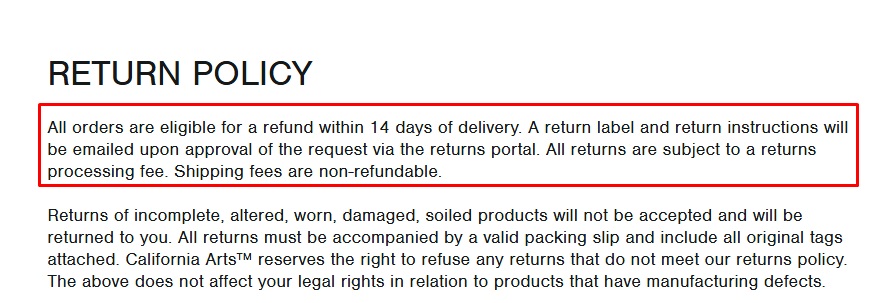
California Arts has a 14 day voluntary returns policy. As this is longer than the minimum of 7 days, and is clearly stated, it overrides the default time limit of 30 days:
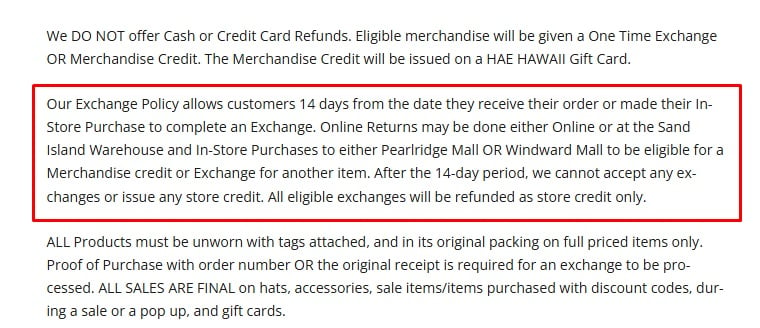
HAE Hawaii has a 14-day time limit for voluntary returns and only offers exchanges and credit. Without this in its return policy, it would have to follow the default rules of a cash refund for 30 days:
Europe

Consumer rights on returns in the European Union are covered by the Consumer Rights Directive (officially known as directive 2011/83/EU), which was issued in 2011 and was updated by directive 2019/2161 in 2019.
In both cases, the directives set out minimum standards which EU member countries had to incorporate into their national laws. Each country is allowed to have laws requiring tougher standards, including longer time limits.
Faulty Goods
Consumers have a minimum of two years to return faulty goods. (Some countries have longer minimums.) During the first six months, the seller must either give a refund or prove the goods are not faulty. After six months, the burden is on the buyer to prove the goods are faulty rather than suffering expected wear and tear.
Sellers have the right to initially attempt to repair the goods or to replace them. If neither of these fix the problem (so the goods can't be fixed and a like-for-like replacement isn't available), they must issue a refund.
Voluntary Returns
Buyers have 14 days to request a voluntary return for non-faulty goods bought through methods such as an online, mail or telephone order. This "cooling off period" starts when the buyer receives the goods.
The customer only has to request the return and refund within the 14 day deadline. They then have another 14 days to return the goods. (After receiving the goods, the seller has 14 days to issue the refund.)
The cooling off period doesn't apply to goods the buyer can see in person before buying. There's no automatic right to return non-faulty goods in this case.
The rules are different for services or digital content. The 14-day period starts when the customer signs a contract. The period automatically ends (meaning the seller doesn't have to accept a voluntary return) if the buyer downloads or streams digital content.
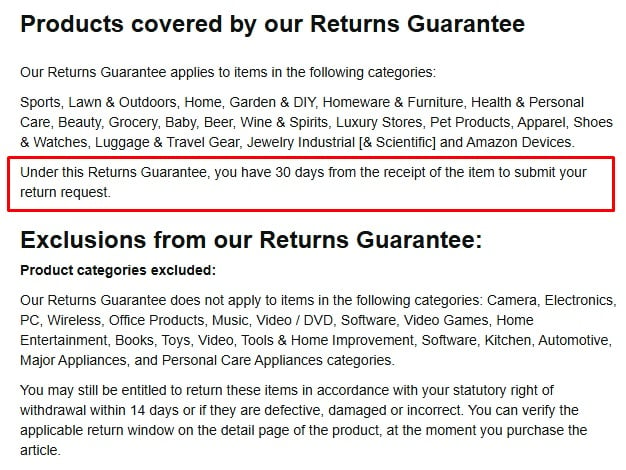
Amazon in Germany chooses to offer a 30-day returns period for voluntary returns on some categories of product. It also makes clear this doesn't cover products in other categories, which thus come under the legally required 14-day returns period:
Other European Countries
The United Kingdom is no longer a member of the European Union. It still uses the Consumer Rights Act of 2015, the national law it passed to implement the 2011 Consumer Rights Directive.
Iceland, Norway and Liechtenstein have agreed to follow the EU's consumer protection laws.
This means that in all four countries the same principles apply: 14 days for voluntary returns and at least two years for returning faulty goods.
The UK lets users make a claim that goods are faulty and request a refund for up to six years after purchase. However, the timescale will vary depending on reasonable expectations for how long the goods would remain fault-free.
For example, you'd usually have to issue a refund for a faulty fridge four years after purchase. However, you wouldn't usually have to issue a refund for a faulty phone charger cable four years after purchase.
Australia

When it comes to refunds, Australia's consumer laws work as much on principles as precise timelines.
For example, a right to get a refund for faulty goods applies, though with "minor" problems the seller only has to fix or replace the goods. Australia also has specific rules that the consumer must return products where it's simple to do so (eg by post) and the business must collect them or arrange delivery in other cases (eg bulky items such as beds).
In all of these cases, exercising these rights or carrying out these responsibilities must be done within a "reasonable time" rather than to a specific deadline.
There's no legal requirement to accept voluntary (non-faulty) returns and thus no deadline for doing so.
Australia does specifically make it illegal to mislead customers about their consumer rights. This includes any false claim of a deadline for requesting a refund for faulty goods.
Canada

Canada does give customers the legal right to a refund for faulty goods, known as a reasonable durability warranty. (This is not the same as a "warranty" in other countries where it refers to the seller guaranteeing goods for longer than the legally required minimum period.)
There's no fixed time limit for refunds for faulty goods. Instead, they must be usable (in normal use conditions) for a reasonable time, depending on the price paid and any conditions of use. For example, an expensive electronic item could be expected to last longer than a cheaper one.
Voluntary (non-faulty) refunds are entirely down to the seller's policy. You can impose a time limit of your choice for requesting such a refund.
How To List Time Limits

Simply listing a time limit for returns and refunds may not be clear enough. Here's some key points to always include:
- When the time limit starts. This could be when a user places an order, when they pay for the order, when they receive the goods or (particularly with a digital product) when they first use the goods or service.
- What must be done within the time limit. For example, you might require that the buyer simply requests the return and refund within the time limit. Alternatively, you could say that they must send the goods back (e.g. through a courier or delivery service) within the time limit, or that you must receive them within the time limit.
- Any exemptions to the standard time limit for specific products.
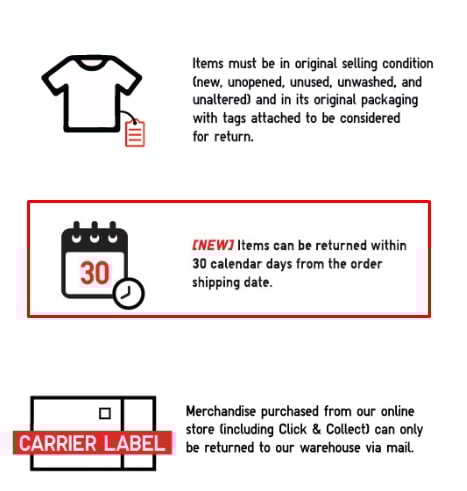
Uniqlo Canada clearly explains when the clock starts on its 30 day return period:
Where To List Time Limits
The best place for any time limit is in a dedicated returns policy. This should include applicable deadlines for initiating or requesting a return; returning the goods; and receiving the refund. It should also include other relevant details such as allowable reasons to return goods, who covers the costs of returning them, the method by which you issue a refund (or store credit) and any fees.
Normally a returns policy works best as a standalone document, which you should refer to as a separated document called Return Policy. If your returns policy is brief, you could include it as part of a clearly organized Terms and Conditions agreement.
Always make sure you can show customers had a reasonable opportunity to read your returns policy before making a purchase. Note that in some US states, you must prominently display your returns policy, otherwise you will be covered by default rules and time limits for voluntary returns.
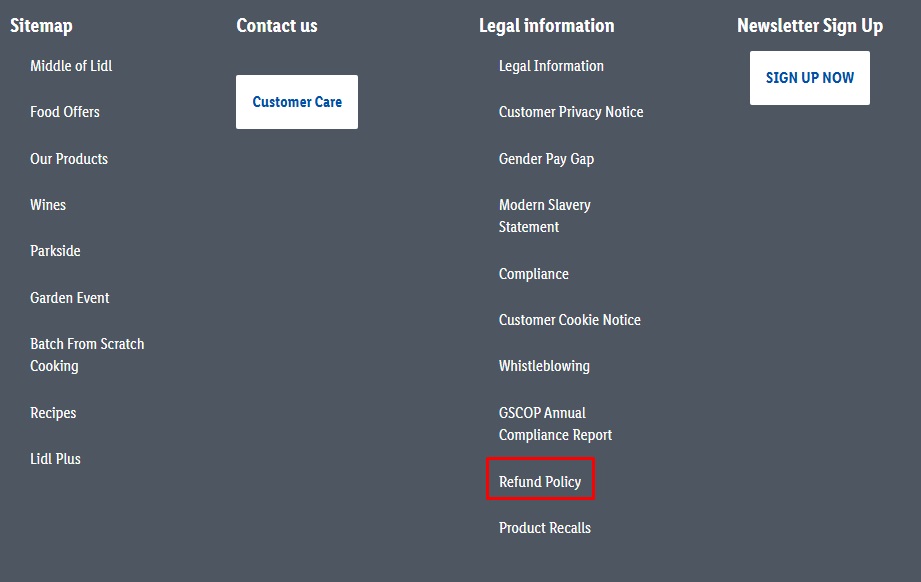
Lidl UK has a dedicated returns policy page on its website, logically placed in the navigation menu alongside similar documents such as its Privacy Policy and cookie notice.
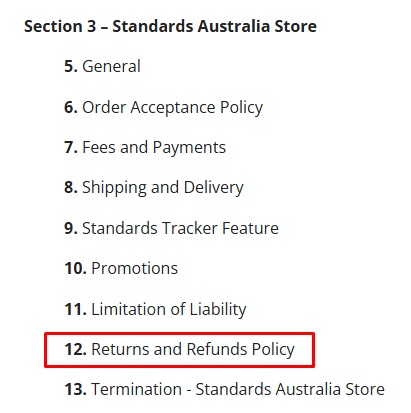
Standards Australia builds its refund policy into its wider Terms and Conditions agreement:
Summary
Time limits for returns and refunds can affect both faulty goods and voluntary returns. These time limits can affect how long a customer has to exercise their rights, and how quickly various elements of the returns process can work.
While some laws set out time limits, it's often down to your returns policy (particularly with voluntary returns.) In some places, a default time limit may apply if you don't have a returns policy to the contrary.
Make sure any time limits you impose on returns and refunds are clearly displayed, for example in a prominent returns policy. Note that some US states have specific rules on how to display your returns policies, for example in physical stores.